Tag Archives: Savoy Jazz

Moncef Genoud Trio, Vitello’s

July 12, 2012


Moncef Genoud Trio

Jazz is constant discovery. Notes become threads, stories become journeys. Artists find a larger audience. Old things are expressed in new and surprising ways. All were elemental to the first of two nights with the Moncef Genoud Trio at Vitello’s. Blind since birth, born in Tunisia, but calling Switzerland home his entire life, he has performed widely throughout Europe, and internationally, his whole career. He is no stranger to the continent’s most important jazz stages, including appearances at Montreux and North Sea. Mr. Genoud’s US performances are special events.


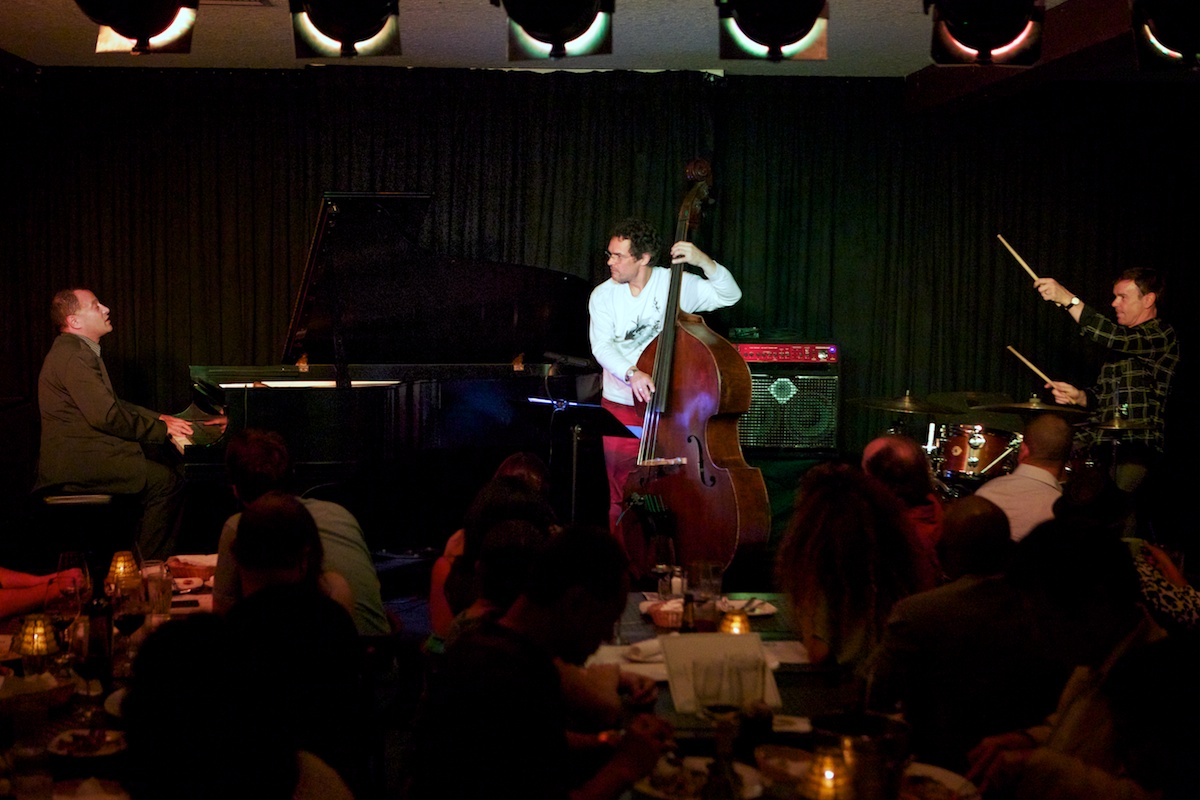
Moncef Genoud performing with his trio at Vitello’s

Mr. Genoud has released 11 studio albums since the late ‘80s , with several distributed through smaller European or Japanese outlets. His last two releases, 2006’s “Aqua” (on Savoy Jazz), and 2010’s “Metissage” (Rollin’ Dice Productions) are a doorway to a remarkable career and talent.  The three covers from “Aqua” (Gershwin’s “Summertime”, Coltrane’s “Moments Notice” and Strayhorn’s “Lush Life”) interpret these compositions with respect and originality (especially “Moment’s Notice” which takes flight under Genoud’s right hand, swinging gently without jumping too high or hard). “Aqua” also features some of the late Michael’s Brecker’s last released recordings. His tenor turns a beautiful companion to Genoud’s compositions (check the climbing and downhill on “Mix of Keys”, classic Brecker). “Metissage” again finds Genoud mixing a few choice covers (including Miles’ “Blue in Green”, Serge Gainsbourg’s “La Javanaise”, and “Diabaram” a Youssou N’Dour and Ryuicihi Sakamoto collaboration) with original compositions. “Chermignon” stands out with a theme at once intimately familiar and totally original. Mr. Genoud cites Evans, Petersen, Tatum, Jarrett, Corea, Hancock and Mehldau as key influences, echoes of which are evident throughout both “Aqua” and “Metissage”. Mr. Genoud is currently working on his next release, one with a very different musical voice, so stay tuned.


Bänz Oester and Moncef Genoud at Vitello’s

The piano based trio is jazz truth for this photographer/writer. Whether in tender ballad retellings, propulsive bop, new interpretations of old standards or the one foot in the traditional the other in the future approach that marks musicians such as Brad Mehldau, the p/b/d trio reveals all. The players must merge as one, retain their voices and take no shelter. That Keith Jarrett’s standards trio (with Gary Peacock and Jack DeJohnette) is nearing its fourth decade bears witness to such enduring musical excellence. The Moncef Genoud Trio is in keeping with that tradition.


Moncef Genoud at Vitello’s

Genoud took the stage at Vitello’s Thursday for his first Los Angeles appearance in six years, accompanied by English drummer Andy Barron (who has played with Kenny Wheeler and John Scofield) and bassist Bänz Oester (who has worked with Michael Brecker and Joe Lovano). Genoud opened with three pieces from “Aqua”. The gently cascading “Out of the Blue” demonstrated a nice ease between players with Oester’s woodsy feel featured early on against Barron’s brushes. “Aqua” found comfortable openings for Genoud to flex the melody with distinctive soloing. “Sliding Shadows”, also from “Aqua” began with Genoud’s string plucked rumblings and Barron’s hand struck snare and quickly picked up steam that took the trio into Jarrett/Mehldau territory on their non-standard days. Throughout the performance, Andy Barron’s taste for cymbal rims and stick ends (and general percussive nuance), seemed in contrast to/keeping with the guy who has a penchant for “bashing various circular objects” according to his MySpace page.


Drummer Andy Barron’s touch for various circular objects

Barron and Oester stepped aside for the Genoud solo piece “Metissage”. The simple theme, and its minor/major, dark/light, low/upper register counterplay, was caringly rendered. Turning feisty, Genoud went at the strings and frame of his grand while vocalizing “Arabic Spring” as an alternative intro to “It’s You” from his fifth album of the same name, and I was struck by the blind musician’s literal feel for the instrument inside and out. The piece took a nice 6/8 turn with echoes of “All Blues”. Genoud’s reading of John Lennon’s “Imagine” brought a hush to the room and was the evening’s highlight. Beginning as a ballad that flirted with a melody emotionally memorized by all, Genoud’s telling ended in bluesy brush driven flourishes. “La Javanaise” followed before the trio brought the echoes of “All Blues” full circle with their own spunky take on the Miles’ classic. The set closed with a cover of Chico Buarque’s “Tu Verras” (originally titled “O Que Sera”) and a satisfying, but relatively brief unnamed encore that capped the 80-minute performance.


Moncef Genoud works the piano inside and out

Mr. Genoud and C. Chill of Rollin’ Dice Productions have forged a unique musical bond. Chill, a songwriter/producer by trade, first met Mr. Genoud about 10 years ago. Musically self-taught, weaned on funk, but a jazz lover as a teen, Chill took Genoud under his wing to distribute “Aqua” to a wider (e.g., US) audience and a special musical collaboration was born. In speaking with Chill after the performance, his passion for working with Mr. Genoud is evident. It is to the benefit of jazz audiences everywhere that Mssrs. Genoud and Chill found each other. They have much more to discover together. A journey worth taking.


Bänz Oester and Moncef Genoud


Posted in Reviews | Also tagged , , , , , , , , , , Leave a comment

Matt Chamberlain Residency with Bill Frisell, The Mint

May 30, 2012


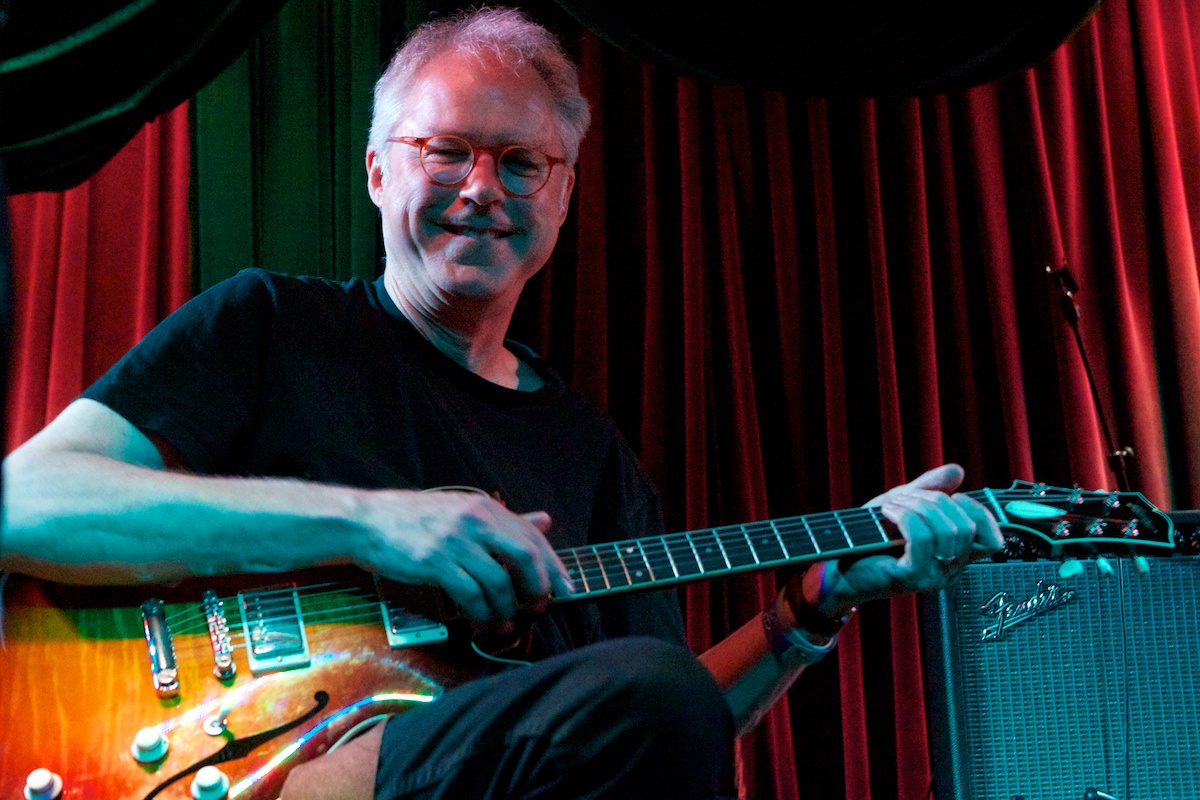
Bill Frisell enjoying himself at The Mint

A guitar’s frequent absence from a jazz arrangement is both a uniqueness of the idiom and distinguishes it from the string driven sound of rock and blues. As an early ‘70s kid I was wide eyed about rock and all about guitars. When I discovered jazz and found horns and keys where strings should be, it both opened me up and whet my appetite. While I knew Joe Pass was the greatest living player of the day and no one could touch Wes Montgomery, I was not drawn to those stylings as I am now. My attention span was short. I was the rock enthused, looking for the rock infused. Jazz crossover in both directions spoke to me. Sure, fusion filled the gap. Early Return to Forever, the Mahavishnu Orchesta. Buried alive under all those notes never felt so good. Yet, it was not enough. I wanted touch, space, soul, too.

The mid-‘70s through the early ‘80s were fertile ground for a fresh approach. Pat Metheny teased new elements into a guitar led quartet with a traditional tone played in untraditional ways and settings. It didn’t attack. It slipped. It flowed. John Abercrombie, was literally, timeless. His 1974 debut album of the same name with Jan Hammer and Jack DeJohnette, was a different kind of “fusion” altogether, using a muted tone and exploratory playing to expand boundaries not by pushing, but by painting. Ralph Towner’s 12-string Guild or nylon 6-string were as comfortable alongside Gary Burton, Chick Corea or Keith Jarrett, as they were creating evocative landscapes with his solo or ensemble work. All left lifelong imprints on my musical psyche.

As with these predecessors, Bill Frisell came on the scene with the ECM label. I collected ECM recordings in all their MOMA-esque presentation like baseball cards. A lot of it was simply too outside for me, but the rest opened my ears in new ways. I first came across Frisell in his early ECM days, through his work with Eberhard Weber, Jan Garbarek and others, but really didn’t take much note. When Frisell moved to the more world, folk and acoustic oriented Nonesuch in the late ‘80s, it was both the beginning of a long relationship with the label, and a foretelling of something special. It was not until the mid-late ‘90s that I caught up with his work in earnest, and a string of recordings that will make my desert island shelf. “Nashville”, “Gone, Just Like a Train” and “Good Dog (Happy Man)” (the latter, I would have bought on the title alone). These were jazz inflected takes on traditional Americana. His version of “Shenandoah” is simply stunning. A few years later, Frisell would turn out “Blues Dream”, a lopey, brooding piece of Main Street splashed with horns and pedal steel. Oh, then he recorded the title tune on a companion project the same year with jazz giants Elvin Jones and Dave Holland, a super trio if there ever was one. Main Street meet Coltrane’s drummer. Now that’s jazz.


Bill Frisell at The Mint

Frisell stayed with Nonesuch until 2009, but before he left he managed to drop in a project, “Floratone” with drummer Matt Chamberlain, on the Blue Note label.  Loaded with effects and rhythmic grooves, and trademark Frisell shimmer, Floratone birthed a sequel, “Floratone II” released in March of this year on Savoy Jazz. Chamberlain, an esteemed session player with over 200 recordings to his credit, has an envious rock and pop resume including stints with Pearl Jam, Tori Amos, the SNL band and his start with Edie Brickell as a New Bohemian. His playing alongside session legend Jim Keltner, on Brad Mehldau’s, 2001 release “Largo”, is one reason that project was one of the most compelling jazz efforts of the new century.  Radiohead’s “Paranoid Android” in a piano setting was boundary changing indeed.


Matt Chamberlain closing out his Mint residency

Matt Chamberlain staked a May residency at the Mint, so it was fitting that he would wrap it with Bill Frisell. I have seen Frisell a number of times over the years in comfortable settings such as McCabe’s and the old Largo, and was genuinely excited to hear these two go at it The Mint, an equally intimate venue I know well.  It was clear from the outset on Wednesday that this would be an unscripted evening of improv proportions. Chamberlain’s vintage wood wrapped kit sat stage left, a shallow wood hooped snare (or two), electronics behind. The unassuming Frisell took his seat, and Largo brain trust and multi-instrumentalist extraordinaire Jon Brion emerged from the shadows stage right, providing an unexpected stringed addition.


Jon Brion and Bill Frisell, making it up and sounding great doing it

This was a percussion driven affair that served up a very different context than any other Frisell show I’ve attended. As the first piece progressed, Frisell seem to be island, then Eastern influenced, then quickly deconstructing in tones that moved from fuzz to church bells. The players found a place to land before starting another exploration with Frisell and Brion playing the outer edges to the oak like heft of Chamberlain’s groove. Morphing from the fringes to a bluesy feel, then devolving again. Frisell found a “Lay Down Sally” informed country road riff that took the next piece to a fulfilling destination. Well worn, comforting. Chamberlain soon introduced loops and other electronic effects, coupling them with machine gun thrills and blocks of spaces. Reminiscent of Bill Bruford and other jazz-rock fusionists of the highest order. Frisell and Brion were something to behold. Brion squelching with feedback and odd tones from his hollow-body, Frisell shining chimey light and warmth, than turning that on a dime.  Deeper in, Chamberlain brought the percussive equivalent to rummaging through an old drawer. If they weren’t old bells, keys or ashtrays, they were awfully close. As the first set eventually found a way home, there were glimpses of Police-reggae flourishes, a slow string driven gallop that grew wings in a hurry, and some stinging soloing delivered from Brion’s Gretsch. Chamberlain often dampening his strikes on a second snare with a bandana.


Matt Chamberlain at The Mint

The second set started with Frisell harmonics circling above Chamberlain’s tom heavy attack, that grew to howling beauty. Soon, all three were stirring what I can only describe as a 1971 “Dark Star” informed jam previously thought extinct. Brion wading deep into Garcia space land. Until the whole thing shifted to a country skiffle. Later in the second set, Brion moved to his SG, banging, tapping on top of high fretwork, coaxing sounds like coiled springs. Frisell’s tranquil side shone with a softer ballad textured piece and his interplay with Brion, each interlocked in ascent with the other above just right-for-the-moment hi-hat sprinkles from Chamberlain. The quiet passed with a vengeance, lost in Brion’s SG swagger and Chamberlain’s cowbell.


Jon Brion, strings attached

This is music that takes shape, breaks apart, takes another shape, breaks apart. Constantly. The trio never stayed anywhere too long. Without fail, Chamberlain, Frisell and Brion opted for the unfamiliar, rather than nestle in for more than a pit stop. Bearing witness to such creation is a joy, unnerving, and completely rewarding at the same time. But only in the right hands. With musicians this inventive, curious and adventurous, it is snowflake singular. It is here and then it’s gone. Ephemeral, deep, well travelled, but never staying long. Like a blues dream.


Bill Frisell, blues dreamer

Posted in Reviews | Also tagged , , , , , , , , , , , , , , Leave a comment