Categories
Search Blog
Archives
Find Me
Tag Archives: The Mint
Billy Cobham’s Spectrum 40 Band, The Mint
January 26, 2013

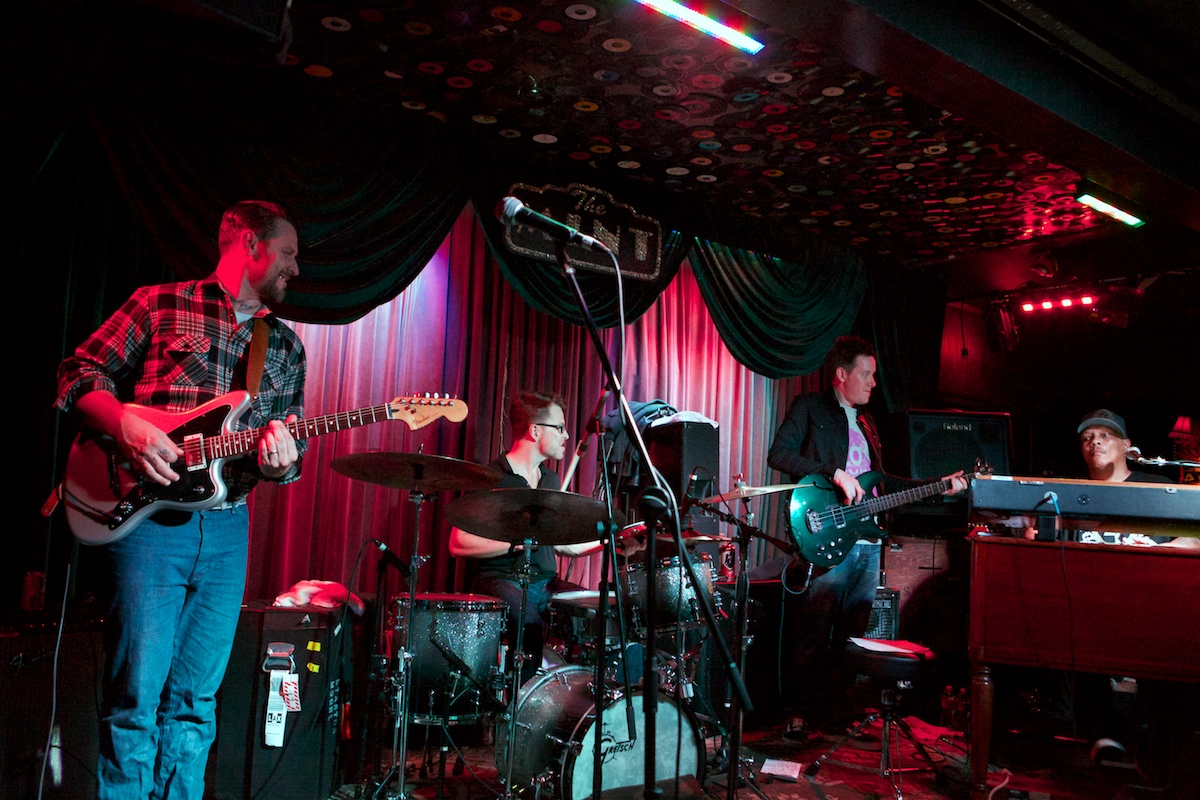
Billy Cobham and Ric Fierabracci at The Mint
Mahavishnu Orchestra is in the pantheon of jazz fusion pioneers. Black hole density, volcanic intensity and ridiculous virtuosity. I had never heard anything quite like John McLaughlin’s searing fretwork, Jan Hammer’s prog-funk sounds and Jerry Goodman’s violin thrown to the front of what truly seemed to be an inner mounting flame. Not for the faint of heart. Beneath it all was drummer Billy Cobham, who played at Mach tempos and time signatures with the necessary muscle to stir the mix.
While Mahavishnu (especially in its original lineup for three brilliant albums) occasionally slowed down, more often than not, there was an avalanche of notes and spaces were usually avoided. The influence of McLaughlin’s Eastern spiritualism was very much present and the music omni-powerful. After Mahavishnu, McLaughlin turned away from the fire and the volume way down with his acoustic Indian trio Shakti, Jan Hammer went on to Miami Vice fame and blazed rock fusion territory with Jeff Beck, and Billy Cobham recorded his first solo album, 1973’s “Spectrum”. Cobham brought along Hammer, session master Leland Sklar on bass and guitarist Tommy Bolin (all of 21, before he went on to play with the James Gang and Deep Purple), as well as the great Ron Carter on acoustic bass and Joe Farrell on reeds/winds. A mix of funk and fusion, Hammer’s trademark mini-moog squelches and electric piano, Bolin’s cross-over agility, and Cobham’s furious chops placed up front, in the middle and sideways, “Spectrum” stands on its own as one of the seminal albums of its genre. Opening with a stampede of toms (“Quadrant 4”) and closing with Crusaders like funk (“Red Baron”), the album still holds up, even 40 years later.
Cobham has been recording at a Woody Allen like pace over the years, with over 40 albums under his own name and a resume that includes Miles, Sonny Rollins, Horace Silver, Quincy Jones, McCoy Tyner and other jazz luminaries too numerous to mention (I’m partial to 1976’s “The Billy Cobham – George Duke Band: Live on Tour in Europe,” with John Scofield and Alfonso Johnson). Looking back on where it started seems appropriate.
To say Cobham is almost machine-like in his playing is more a testament to his strength and precision than a description of his breakneck pacing and explosive fills. In fact, on more recent listening, it is Cobham’s snare that is the constant. Always bubbling and percolating under whatever he is playing. While his double kick drum set up is rock in posture, it should not be taken as a jazz equivalent of Spinal Tap. Far from it (though I was curious how his traditionally monster kit plus band would fit on the snug Mint stage).
The Spectrum 40 tour reunites Cobham with Mahavishnu violinist Jerry Goodman, with Cobham vets Dean Brown on guitar, Gary Husband on keys and Ric Fierabracci on bass. The tour had been in the Northeast and followed that up with West Coast dates in L.A, Santa Cruz and Oakland.

Jerry Goodman locking in with Dean Brown

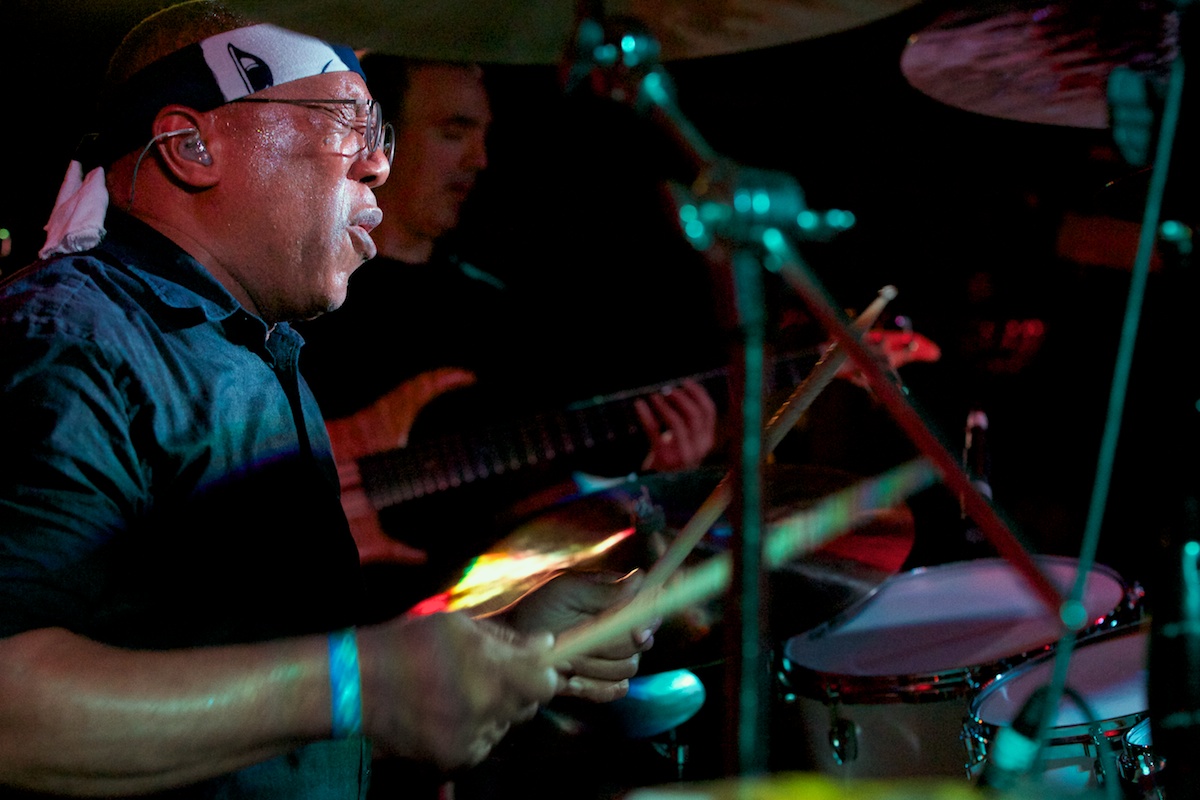
Billy Cobham performing with the Spectrum 40 Band at The Mint

Former Mahavishnu Orchestra violinist Jerry Goodman
Beginning with a snare roll that barreled into the theme of “Mushu Creole Blues” (from 1994’s “The Traveller”), the Spectrum unit started to swing quickly as Goodman and Brown enthusiastically tangled with each other. Husband’s topically named “If the Animals Had Guns, Too” (from his 2012 release, “Dirty & Beautiful, Volume 2”) went to darker, freer corners in a more compact tune. Husband is an exceptional drummer in his own right, which must bring added intuition to his keyboard interplay with the bandleader. Cobham was relaxed and loose with the crowd as he introduced the band, admittedly a bit “fuzzy” after their escape from New York, just before a Nor’easter shut down travel. After the intros, the band jumped into Dean Brown’s “Two Numbers” (from Brown’s 2012 release, “Unfinished Business”), which found an interesting African marimba like feel at its mid-point. An extended Cobham solo stitched rhythmic fits and starts into a locomotive, mixing sheets of tom fills with his snare and cymbals, drawing the snare down to the barest paradiddle before an inundating flurry of strikes that launched “Stratus” (from the original “Spectrum” album and a fusion “greatest hit”, deservedly so). This being the first time I saw Cobham live, I was struck by how he played such a large kit (2 kicks, 2 floors, 4 rails and enough metal to melt into a car) like one half its size. That’s finesse.

Dean Brown, Strat in hand

Billy Cobham, doubling up on the sticks

Billy Cobham, from a paradiddle to a roar

Dean Brown locking in with Jerry Goodman
The second set began with Goodman’s “Brick Chicken” (from 1999’s, “Stranger’s Hand”, a collaboration of Goodman, harmonica player Howard Levy, drummer Steve Smith and bassist Oteil Burbridge), and a flat out boogie that wouldn’t be out of place as a jam band crowd pleaser. “Fragolino” (also from “The Traveller”) and Ric Fierabracci’s “Sphere of Influence” (from 2007’s “Hemispheres” with Phil Turcio, Brett Garsed and Joel Rosenblatt) brought some (relatively) gentler passages between feverish highs. The set closed on the heels of another Cobham solo with “Quadrant 4”(from “Spectrum”), a total stomp with rock hero sensibilities and a 405 pileup of a crescendo. “Red Baron” had to be the encore (which also appropriately closes “Spectrum”), the band returning to its feel good theme many times over and leaving the stage to a very happy and appreciative audience. This was an outstanding night of music and the material a worthy revisit 40 years later.

The Cobham touch
A special shout out to The Mint. The Spectrum 40 show was the second KKJZ sponsored event at the venue in a week (following Joe Lovano and the US 5 with Esperanza Spalding), and if these shows are any example, the versatile booking of The Mint is a welcome and vibrant addition to the Los Angeles jazz scene. The room is a not a traditional clinking glasses, hushed at your seat jazz club. It is informal, open and intimate (but be prepared to stand). With Stanley Clarke leading his band through a three date run across town, not a bad week for Los Angeles jazz either.

Billy Cobham
Check out this recent interview with Billy Cobham talking about the tour and the band. Good stuff.
For the drummers reading this, Billy Cobham also teaches online at ArtistWorks (and gives students feedback on their playing, really). Pretty cool.
Posted in Reviews
Also tagged Billy Cobham, concert photography, Dean Brown, Eye on the Music, Gary Husband, jazz, jazz fusion, jazz photography, jazz violin, Jerry Goodman, Jim Brock Photography, live music, Mahavishnu Orchestra, music photography, Ric Fierabracci, Spectrum 40, Stratocaster, Yamaha drums
Leave a comment
Dragon Smoke, The Mint
December 12, 2012

All eyes are on Ivan Neville during Dragon Smoke’s rare gig at The Mint
Certain celestial alignments skip decades, if not lifetimes, or at a minimum, involve covering great distances at greater expense. Think solar eclipses, Comet Hale-Bopp or if you get around, the aurora. Even then, there is the unexpected cloud cover that can scotch the most anticipated and well-planned events. While the intersection of talent that is Dragon Smoke may not operate on a celestial plane, the fact the band exists, let alone has endured for a decade, is pretty damn impressive. Comprised of the Galactic’s drummer Stanton Moore and bassist Robert Mercurio, guitarist/songwriter Eric Lindell and funk master Ivan Neville on keys and vocals, the band is a potential one-off that never offed. The lineage speaks propulsive, jammy funk meets soulful vocals as one would expect with the Galactic rhythm section, stinging Lindell leads, swampy Neville keys and alternating Neville/Lindell voices. They deliver that and then some.

Dragon Smoke’s/Galactic’s rhythm section of Stanton Moore and Robert Mercurio
The demanding tour schedules of Galactic, Dumpstaphunk and Lindell, coupled with additional musical pursuits, make the right place/right time convergence of the four principals slightly more frequent than a Cubs post-season appearance, or at least cause for celebration. Yet, the band has been a fixture for 10+ years on the Tuesday between Jazzfest weekends, while managing to pop up for rare winter forays west of the Mississippi, including another December gig at The Mint as part of a 5-date West Coast-ish swing. Their show last year killed and was of one the room’s most memorable of 2011.

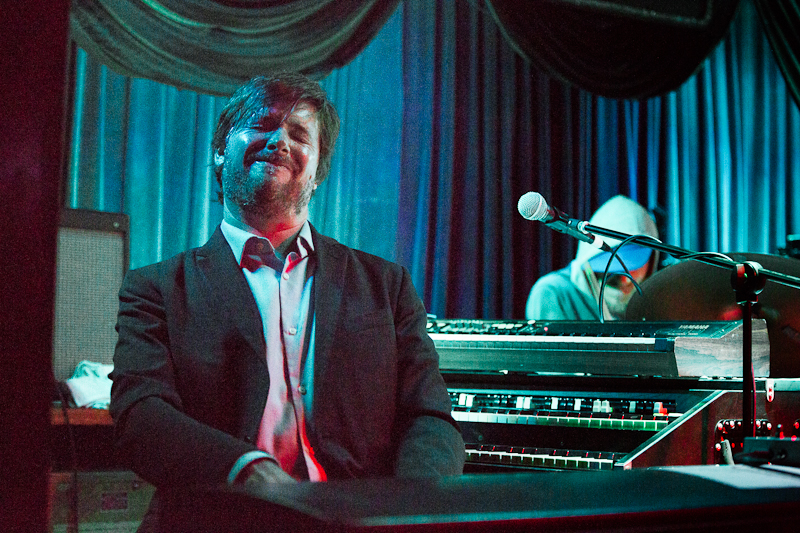
Ivan Neville having a good time at The Mint
The musical affection between the players is obvious from the get-go. Like a family reunion where you don’t see enough of each other, stay up all night, then go on with your lives until the next one. The material is generously shared and enthusiastically played. And while many similar collaborations often lose focus, tread on reputation or simply go sideways, these guys play for keeps. It sure doesn’t feel or sound like a side project.

Robert Mercurio with Dragon Smoke
Opening with the country ramble feel of “Sunday Morning”, the trademark swapping of Lindell and Neville led tunes jumped right into the Dyke and the Blazers funk of “Let a Woman, Be a Woman” with Stanton Moore sneaking in a NOLA brass snare rhythm between a barrel full of fills, and Neville chomping at his clavs and working his B3. Funky, fun, and delicious. The stutter step blues rock of Lindell’s “Country Livin’” (from 2009’s “Gulf Coast Highway”) sounded pretty damn good, accented by Neville’s Hammond runs and Moore’s cascades, and the War-like soul of father Aaron’s “Hercules” brought things back to an appropriate simmer. A couple of Lindell tunes followed, including “Two Bit Town” (from 2006’s “Change in the Weather” and the pretty “Lullaby for Mercy Ann” (from “Gulf Coast Highway”). The Meters were in the room with “Out in the Country” (“nobody plays it like this” professed Neville), before Lindell stretched out with the breezy “Valerie” (a Zutons’ song most notably covered by the late Amy Winehouse). The first set closed with Gerald Tillman’s (aka, Professor Shorthair) “Padlock” (from Neville’s 1995 “Thanks”) anchored by Neville’s B3 and clav blend punctuated by Lindell’s needle stick delivery and a perfect Meters-esque groove over the lines “somebody’s been sleepin’ in my bed”.

Eric Lindell, stinging leads and soulful vocals

More Moore is always good
The sold out room had a climate closer to a Bikram yoga class than the cool rainy weather outside, so some oxygen was in order for the break. By the time the band returned for their second set, everyone was a bit more refreshed and most stayed.

The clav-B3 combo of Ivan Neville fueled both sets
The 10-song set went appropriately deeper than the first. Bill Withers’ “Grandma’s Hands” began with spare soulful “uh-huhs” from Neville and built into a creeping, slippery jam that had the crowd singing the “like the way you work it” chorus part of the tune. One of the night’s high points, for sure. The band brought a relaxed loping ‘tude to the Mardi Gras Indian driven “Indians, Here Dey Come” and even a touch of Dead influence meets NOLA backbeat to it, thanks to some Jerry-like inflections from Lindell and Moore’s expansive snare vocabulary. Another Lindell tune, “Won’t Be Long” (from “Change in the Weather”) featured a slow voltage bridge and blue-eyed soul progression that lives in Lindell’s wheelhouse. “Slippin’ Into Darkness” is such a natural cover for the band, they should have written the classic. All the pieces fit just right. Dropping in a “Get Up, Stand Up” tease, then flipping into The Meters “Fire on the Bayou” and again to Steve Miller’s “Fly Like an Eagle”, before landing back to “Slippin’” was pretty fine. Curtis Mayfield’s “If There’s a Hell Below (We’re All Gonna Go”) was sandwiched between a few more Lindell tunes that brought the set to a close, and featured some well past midnight clav explorations by Neville. The clock was pushing 1 AM on an early Thursday morning by the time the encore of Billy Preston’s “Will It Go Round in Circles” had wrapped.

Stanton Moore was killing it all night long
Robert Mercurio’s recent interview with jambands.com is illuminating reading on how these guys find a way to stick together, and the glue that makes it happen. With grueling schedules and commitments all over the place, the band must want this pretty bad (heck, it would be way easier not to do it). Nonetheless, you may have a better chance of catching an eclipse some years, so best to presume their next orbit is their only orbit. If you are in NOLA the days between the Fest or within hollering distance of their brief trips west, consider yourself lucky and get your ass down to One Eyed Jacks or other respectable live music establishment. This constellation may not come around again, and if it does, you better be there.

Ivan Neville with Dragon Smoke at The Mint
Bombino, The Mint
September 18, 2012

Bombino and band at The Mint
Tuareg guitarist Omara “Bombino” Moctar was born in a nomadic encampment in Niger in 1980. Some 26 years later he was playing alongside Keith Richards and Charlie Watts in California. The here to the there and now is an amazing life of cultural and political conflict, creativity and inspiration that speaks to the global language at the heart of world music today.

Tuareg guitarist Bombino
As a younger guitarist, Bombino would emulate Hendrix and Knopfler licks from watching videos and his path as a musician was carved early, much to the consternation of his father. In 2009, film maker Ron Wyman, who knew Bombino’s music, found Bombino living in exile and brought him to the States to record what became the 2010 release “Agadez”. A truly amazing journey that has had Bombino appearing at major festivals, including this year’s New Orleans Jazz and Heritage Festival, where he absolutely tore up the Blues Tent (a set I unfortunately missed). A new project is on the way and he has played/is playing dates in California and the Southwest before starting a European tour later in the Fall.

Bombino and band at The Mint
His Tuesday night performance at The Mint transformed the seen it all history of the place to a room of swaying bodies, meditative vistas and feverish jams. Beginning with a series of rolling acoustic pieces, Bombino would build upon an initial melody in waves that would come and go, yet always evolve. His acoustic guitar and vocals blending beautifully with two hand drums (one, a rather large globe sized gourd) and a second guitar. Tunes began loping and gentle, picking up in intensity, constantly moving under Bombino’s finger fed “picking”. I could practically see the stars in the northern Saharan sky.

Bombino’s acoustic material was beautifully evocative
After four pieces, the band plugged in with a lead/rhythm/bass/drums format. The first tune flowed back and forth under Bombino’s melody, with flights of soloing that would float and merge. The next brought a darker shade with a 60s’ blues rock feel to the Tuareg sound. On subsequent numbers, Bombino’s western rock influences crept in and the energy went from elastic to ecstatic. One with a pulsing 6/8 feel reminiscent of “Déjà Vu” in warp drive, punctuated by stinging clusters of notes from Bombino, another with a pendulum swing of rhythm inseparable from the melody. As the set came to a close with “Tar Hani (My Love)” from “Agadez” it was impossible not to have some Tuareg in your soul. “Tar Hani”’s seductive guitar intro giving way to Bombino’s comforting and knowing vocals atop a totally bluesy and hypnotic undertow. The thrill of the night, however, had to be the jam rocky encore that fully unleashed Bombino’s Tele-toned fretwork with the entire band in stride.

Bombino bringing a little higher consciousness to The Mint
This was a special night. A musical reminder of our own humanity, uniqueness and commonality.

Stinging clusters of notes and swirling rhythms
I was fortunate to connect with Bombino for a few pre-show questions with Wesley Hodges of LiveMusicBlog.com. In it, Bombino speaks to the universality and cultural influence of his music, playing with Keith Richards and how his guitar is an extension of his body, like “another limb”. Check it out.

Bombino, one world is enough for all of us
For more on Bombino, please also see his official bio and website.
Posted in Reviews
Also tagged Bombino, concert photography, Eye on the Music, Jim Brock Photography, live music, music photography, Tuareg, world music
Leave a comment
The Revivalists, The Mint
September, 11, 2012

Ed Williams and David Shaw of The Revivalists at The Mint
Jazzfest’s surprise moments can happen any time. One of mine came this year when The Revivalists kicked off the Fest from the Gentilly stage before noon on the opening Friday. While the band has played the Fest the past few years, I was in the dark until that set. Familiar to many native Orleaneans and carving a broader audience through touring in support of acts such as Dr. John, Trombone Shorty and Galactic (and in the next few weeks, Gov’t. Mule), their Fest set was passionate, captivating, and raised the bar early for one of the better Fests ever. Led by guitarist/vocalist David Shaw, the band puts Ed Williams blazing pedal steel right up front with horns, keys and a committed rhythm section to deliver what the esteemed David Fricke dubbed “a Crescent City-rhythm spin on jam-band jubilee”. To my ear, this is soul-jam influenced rock from New Orleans, with the New Orleans influences taking more of a back seat to driving and occasionally chimey guitars, Shaw’s growl and an undeniable we came to play stage presence (Shaw’s off stage forays and Williams overtopping his pedal steel were sweet spot material for this photographer).

Ed Williams and Rob Ingraham of The Revivalists
The Revivalists found each other in 2007 and have three CDs under their belt – their eponymous debut EP from 2008, 2010’s “Vital Signs” and this year’s “City of Sound”, which was produced by Ben Ellman of Galactic and mixed by Count (aka, Michael Eldridge), who’s worked with the Stones, Radiohead, Pink, No Doubt, as well as Galactic and Trombone Shorty. Their Mint date is part of a September swing through California and Nevada and I was curious how their Gentilly size presence would fit the room.

David Shaw, Zack Feinberg and Rob Ingraham at The Mint
The small, but devoted, Tuesday night crowd grew in size and enthusiasm as the band worked its way through a deep 80-minute set. Opening with Zack Feinberg’s ES-335 fueled riffs on “Concrete (Fish Out of Water)” from 2008’s “The Revivalists”, the tune caught fire right away. Ed Williams’ sacred steel wasted no time meshing and mashing with Shaw and Feinberg’s twin guitars. “All in the Family” and “Monster” are new tunes, the former bringing a stomping, rapped up rhythm to a chorus of “I’ve got that feeling in my bones”, and whether playing to a living room or thousands, David Shaw sells that line true. Steel on top of blues driven funk just brings it home. “Monster” is a softer tune built around Shaw’s vocals, Feinberg’s waterfall runs and Rob Ingraham’s sax, and an appropriate lead in to “Not Turn Away” from “Vital Signs” with its shuffle step plea of “I hope that you were listening/when I said that you could be the only one”.

Zack Feinberg sporting a mighty ‘stache along with some tasty fret work

Ed Williams, fiery steel playing and excitable, too

The Revivalists’ George Gekas
The ghostly, “Pretty Photograph” from “City of Sound,” sounds nothing like New Orleans and was one of best tunes of the night, blending Williams sweet turn up top with Rob Ingraham’s baritone below. The punchy “Common Cents” from “The Revivalists”, and “When I’m Able”, “Up in the Air” and “When I Die” from “City of Sound” followed. “Up in the Air’s” catch up phrasing landing squarely on the chorus and building to a satisfying finish under Zack Feinberg’s uncolored gallop. By this point in the set, tables gave way to the dance floor and a 40ish dude leading the pack made a point of telling me he drove 3 hours to catch the gig. “Let It All Out” was another new tune that bounced between a ragey bridge and more ballady chorus and fell a little short of other tunes. The rest of the set included the reggae lilt of “Sunny Days” from “The Revivalists”, “Catching Fireflies” from “Vital Signs”, and “Criminal” the obvious closer from “City of Sound”. “Criminal” brings many of the band’s best elements together, tearing up the Fest and capping off this night at The Mint nicely.

Vocalist/guitarist, David Shaw early in The Mint set
I caught up with Rob Ingraham after the show for some set forensics. No set lists, just shout outs from the stage. Wouldn’t have known it as it all hung together rather well.

Rob Ingraham at The Mint
There is romance in the Revivalists sound. Songs feel like love close, beaten or out of reach. Delivered with inspiration and perspiration and a New Orleans heartbeat. A band that also knows where it’s going and determined to get there. I’d count on it.

The Revivalists delivered
Posted in Reviews
Also tagged Andrew Campanelli, concert photography, David Shaw, Ed Williams, ES-335, Eye on the Music, George Gekas, Jim Brock Photography, Les Paul, music photography, New Orleans Jazz and Heritage Festival, New Orleans music, pedal steel, Rob Ingraham, rock photography, The Revivalists, Zack Feinberg
Leave a comment
Honey Island Swamp Band Returns to The Mint
August 14, 2012

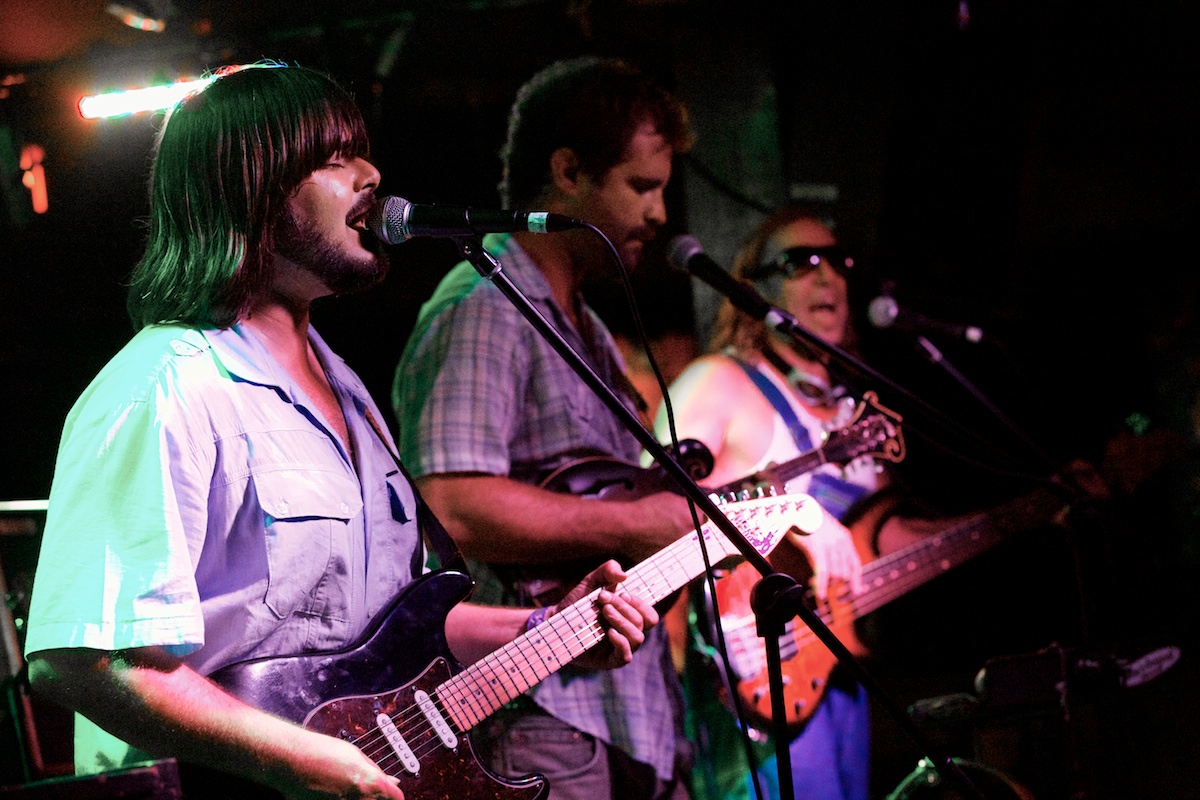
Chris Mulé, Aaron Wilkinson and Sam Price, the HISB frontline at The Mint
It’s apropos that the Honey Island Swamp Band would return for a summer gig at The Mint following an appearance at Outside Lands the prior weekend. After all, the Bay Area figures so prominently in this NOLA band’s origin story. Stranded by Katrina. Crescent City players a long way from home. Meet up on the west coast. Bond big time. Keep their chops strong. Throw a few songs together. Land a regular gig in the heart of town. Cut their debut in the one and only Record Plant in Sausalito. It could only happen….where?

Chris Mulé, Aaron Wilkinson and Sam Price diggin’ in at The Mint
This is their third trip to The Mint in 14 months. That’s not a bad thing. Whether it’s covering their LA dates, staking their ground from the big stage at the Fest or enjoying their pop up everywhere Fest club dates, I have been a fan since first catching them at Jazzfest in 2008. The Bay Area meets bayou influences are everywhere in the HISB sound. Solid songwriting, tight arrangements and enough room to stretch, their self-coined “bayou americana” is rootsy strings first stuff. Swamp driven, but not dripping, and often sprouting ensemble fed jams from tasty hooks, HISB sets include staples from their first three albums “Honey Island Swamp band (2007), “Wishing Well” (2009) and “Good to You” (2010), and more recently, new material from a pending fourth release.

Aaron Wilkinson and Sam Price are good to you…
Guest Robert Walter was on hand to thicken the gumbo a bit. Many an HISB gig add horns up top, so it’s a fresh twist to double down with Walter and Trevor Brooks on keys. Behind the stringed attack of frontmen, Aaron Wilkinson who moves between his Thinline Tele and mandolin, and Chris Mulé’s excellent Strat fed slide work, HISB serves up material reminiscent of Little Feat, Creedence, Black Crowes and many of the band’s NOLA peers, while remaining totally original. Sam Price’s stage energy is only exceeded by the pulsing, bubbling work on his Lakland bass. Garland Paul is a great foil for Price and the rhythm section drives and roots a band that feeds one another with spirited stage IQ in a deceptively comfortable musical setting.

Mint denizen and former Greyboy, Robert Walter

Sam Price, OshKosh cover boy

HISB drummer Garland Paul at The Mint
Opening with the country ramble of “Honey” (from “Good to You”), the tune had Trevor Brooks off to the races. “Josephine”, (also from, “Good to You”) is simply a good time song of love on the road with a great hook. Some muscular playing from Price and kick ass exchanges between Chris Mulé and Trevor Brooks drove that point home. Walter’s jazzier inclinations added another layer to the already jammy “Chocolate Cake” (from “Good To You”) and his soul jazz sound on his own “Snakes and Spiders” (from his 2008 release, “Cure All”) and later in the set, “Hard Ware” (from 2005’s “Super Heavy Organ”) and “Quantico, VA”, were an intriguing match for HISB that worked better than expected. “300 Pounds” (from “Good To You”) is a classic tale of weed running that again had Mulé satisfyingly meshing with four hands on the keys. “Slip” from their self-titled debut and “One Shot” (unreleased) were feisty, with the latter beginning with a reggae on the bayou feel and the former featuring some nice wah-wah like effects from Mulé, when the band was not hugging the go to m7/dom 9 change. Throughout the set, Aaron Wilkinson’s mandolin work showed how much that little box can rock, when he wasn’t tangling Fenders with Mulé or working a hot summer day harp in to the mix. His 8-string touch on “One Shot” climbed all around the blues step of the tune.

Aaron Wilkinson, 8-stringing

Chris Mulé and and shadow lurker Trevor Brooks
No song captures the musical strengths of HISB like “Wishing Well” (from the 2008 release of the same name). Swampy riffs, a sing along chorus and deep stretches of purposeful jams. At The Mint, the snaky intro, Mulé’s slide and the ensemble spirit had me deja vuing for long lost brain cells. “Till the Money’s Gone” (from “Wishing Well”) is an all NOLA romp and “Jitterbug Swing” (an old Bukka White tune, also unreleased) is fleet footed front porch bluesgrass. “Cane Sugar” (unreleased) and “Country Girl” (from “Good To You”), with its Van Morrison if he could boogie flavor, closed things out.

Sam Price gets high on the neck

Garland Paul
Singer/guitarist Clarence Bucaro opened the show with a well received set culled from his five albums, including the just released “Walls of the World”.

Clarence Bucaro during his opening set
HISB is deceiving. The tunes feel like your own backyard throwdown, but go deeper. The funk, blues, bluegrass, jam, country, bayou sound they have cultivated will satisfy jam fans and roots devotees alike. Fest vets know what I’m talking about and the thousands who caught them Saturday at Outside Lands do too. And they just keep getting better.

HISB, one hand on the wheel at all times
Posted in Reviews
Also tagged 20th Congress, Aaron Wilkinson, Chris Mule, concert photography, Eye on the Music, Fender guitar, Garland Paul, Greyboy Allstars, HISB, Honey Island Swamp Band, Jim Brock Photography, Lakland bass, New Orleans Jazz and Heritage Festival, New Orleans music, Robert Walter, rock photography, Sam Price, Stratocaster, Telecaster, Trevor Brooks
Leave a comment
Robert Walter Residency, with the 20th Congress, The Mint
June 13, 2012

Feeling vinyl with Robert Walter and Simon Lott at The Mint
There is no sound quite as satisfying as a Hammond B-3 organ through a Leslie speaker. In the right hands, the B-3 can be pure blues drenched, Sunday church joy, straight up bop, prog rock majesty, soul master and classic rock anchor. While the last B-3 rolled off the line in the mid-70s (says Wiki), the legacy of the sound is completely unmistakable. It has been a signature for the likes of Gregg Allman, Stevie Winwood, Keith Emerson, Booker T. Jones, Stephen Stills, Jimmy Smith, Ray Manzarek, to name but a few. More recently, a newer generation of players, some with deep New Orleans ties, have led B-3 driven ensembles including the likes of Marco Benevento, LA’s own Mike Mangan and Robert Walter, who began a June residency at The Mint last week.
Southern California native and New Orleans resident Walter chose his Mint residency to reconvene the 20th Congress for their first performance in 5 years. The former Greyboy launched the Congress in the late ‘90s and counts Stanton Moore, Will Bernard and Joe Russo among its alumni. This gig featured original Greyboys Walter and Chris Stillwell, bass, with Cochemea Gastelum, sax/flute (Sharon Jones), Chuck Prada, percussion (Snoop Dogg), and Simon Lott, drums (George Porter, Jr.). The 20th Congress moves from straight up horn and keys driven funk and blues, to the more quixotic, while right at home in the soul jazz spectrum. Like Marco Benevento, Walter mixes the B-3 sound with electric keys and occasional effects.

Simon Lott, sans hoodie
While Walter did not have his B-3 in tow for this gig, his Yamaha nicely emulated the experience through a vintage Leslie. Another rack of keys sat atop the Yamaha and (to my delight) a Fender Rhodes filled out the array. Opening with the chunk of funk “Sweetie Pie”, the 20th jumped right into the fray led by some fine Rhodes work and Gastellum’s alto. The next tune started with an extended Walter solo, then had drummer Simon Lott, hoodie and all, drop into a hard groove and pretty soon it was feeling like 70’s vinyl. No surprise the set list revealed the third tune to be from Walter’s 1997 release “Spirit of 70” (“Corry Snail and Slug Death”, no explanation to that one). Gastellum switched to flute for the next tune “Fathom 5”, from his 2010 solo release “The Electric Sound of Johnny Arrow”. The piece started spare, with Gastellum’s flute and Walter’s reverbed Rhodes a snug unit, bassist Stillwell adding a tease of samba undercurrent.

Cochemea Gastellum with the 20th Congress
Walter was easy and chatty with the crowd and introduced “Dog Party” with good humor. Disclosure, I love the Fender Rhodes sound almost as much as a B-3, whether it’s early Chick Corea or Royal Scam era Steely Dan. Walter did not disappoint, moving into territory that would make the 1973 Eumir Deodato proud. The set closed with “Who Took the Happiness Out”, a Dirty Dozen Brass Band composition, and a great showcase for the entire 20th .

Robert Walter, Simon Lott and Chris Stillwell convening the 20th
The second set kicked off with “Movin’ on Out” and as the set progressed, a few guests spelled Simon Lott and Chris Stillwell for a tune each, stepping in pretty seamlessly, given some of the angled time signatures. Walter also dug more into his effects pedal, pushing the Rhodes tone to its edges and back again. The set list revealed songs from 2001’s “There Goes the Neighborhood” (“2% Body Fat”), 2008’s “Cure All” (“Maple Plank”, “Snakes and Spiders”) and 2005’s “Super Heavy Organ” (“Adelita”, “Kicking Up Dust”). Apparently, one of the tunes had something to do with brushing your teeth, but hey, that’s instrumental titling for you.

Chuck Prada with the 20th Congress at The Mint
The 20th Congress is often fast paced. Borderline frenetic, but not overly hyper. Always finding a groove to draw your attention. Along the way, Robert Walter will move from bluesy flourishes to dizzying ascending/descending runs. At least a few times Wednesday my head checked Welcome to the Canteen era Traffic and Caravanserai era Santana while the 20th was rolling. This is not retro stuff, just a continuation of a story and great sounds fully embraced. Me, I never left the time zone, so it works rather well.

Robert Walter, Simon Lott and guest
Robert Walter continues his residency at The Mint on June 20th (with Reed Mathis and Aaron Redfield) and June 27th (Stanton Moore and Jonathan Freilich).
Matt Chamberlain Residency with Bill Frisell, The Mint
May 30, 2012

Bill Frisell enjoying himself at The Mint
A guitar’s frequent absence from a jazz arrangement is both a uniqueness of the idiom and distinguishes it from the string driven sound of rock and blues. As an early ‘70s kid I was wide eyed about rock and all about guitars. When I discovered jazz and found horns and keys where strings should be, it both opened me up and whet my appetite. While I knew Joe Pass was the greatest living player of the day and no one could touch Wes Montgomery, I was not drawn to those stylings as I am now. My attention span was short. I was the rock enthused, looking for the rock infused. Jazz crossover in both directions spoke to me. Sure, fusion filled the gap. Early Return to Forever, the Mahavishnu Orchesta. Buried alive under all those notes never felt so good. Yet, it was not enough. I wanted touch, space, soul, too.
The mid-‘70s through the early ‘80s were fertile ground for a fresh approach. Pat Metheny teased new elements into a guitar led quartet with a traditional tone played in untraditional ways and settings. It didn’t attack. It slipped. It flowed. John Abercrombie, was literally, timeless. His 1974 debut album of the same name with Jan Hammer and Jack DeJohnette, was a different kind of “fusion” altogether, using a muted tone and exploratory playing to expand boundaries not by pushing, but by painting. Ralph Towner’s 12-string Guild or nylon 6-string were as comfortable alongside Gary Burton, Chick Corea or Keith Jarrett, as they were creating evocative landscapes with his solo or ensemble work. All left lifelong imprints on my musical psyche.
As with these predecessors, Bill Frisell came on the scene with the ECM label. I collected ECM recordings in all their MOMA-esque presentation like baseball cards. A lot of it was simply too outside for me, but the rest opened my ears in new ways. I first came across Frisell in his early ECM days, through his work with Eberhard Weber, Jan Garbarek and others, but really didn’t take much note. When Frisell moved to the more world, folk and acoustic oriented Nonesuch in the late ‘80s, it was both the beginning of a long relationship with the label, and a foretelling of something special. It was not until the mid-late ‘90s that I caught up with his work in earnest, and a string of recordings that will make my desert island shelf. “Nashville”, “Gone, Just Like a Train” and “Good Dog (Happy Man)” (the latter, I would have bought on the title alone). These were jazz inflected takes on traditional Americana. His version of “Shenandoah” is simply stunning. A few years later, Frisell would turn out “Blues Dream”, a lopey, brooding piece of Main Street splashed with horns and pedal steel. Oh, then he recorded the title tune on a companion project the same year with jazz giants Elvin Jones and Dave Holland, a super trio if there ever was one. Main Street meet Coltrane’s drummer. Now that’s jazz.

Bill Frisell at The Mint
Frisell stayed with Nonesuch until 2009, but before he left he managed to drop in a project, “Floratone” with drummer Matt Chamberlain, on the Blue Note label. Loaded with effects and rhythmic grooves, and trademark Frisell shimmer, Floratone birthed a sequel, “Floratone II” released in March of this year on Savoy Jazz. Chamberlain, an esteemed session player with over 200 recordings to his credit, has an envious rock and pop resume including stints with Pearl Jam, Tori Amos, the SNL band and his start with Edie Brickell as a New Bohemian. His playing alongside session legend Jim Keltner, on Brad Mehldau’s, 2001 release “Largo”, is one reason that project was one of the most compelling jazz efforts of the new century. Radiohead’s “Paranoid Android” in a piano setting was boundary changing indeed.

Matt Chamberlain closing out his Mint residency
Matt Chamberlain staked a May residency at the Mint, so it was fitting that he would wrap it with Bill Frisell. I have seen Frisell a number of times over the years in comfortable settings such as McCabe’s and the old Largo, and was genuinely excited to hear these two go at it The Mint, an equally intimate venue I know well. It was clear from the outset on Wednesday that this would be an unscripted evening of improv proportions. Chamberlain’s vintage wood wrapped kit sat stage left, a shallow wood hooped snare (or two), electronics behind. The unassuming Frisell took his seat, and Largo brain trust and multi-instrumentalist extraordinaire Jon Brion emerged from the shadows stage right, providing an unexpected stringed addition.

Jon Brion and Bill Frisell, making it up and sounding great doing it
This was a percussion driven affair that served up a very different context than any other Frisell show I’ve attended. As the first piece progressed, Frisell seem to be island, then Eastern influenced, then quickly deconstructing in tones that moved from fuzz to church bells. The players found a place to land before starting another exploration with Frisell and Brion playing the outer edges to the oak like heft of Chamberlain’s groove. Morphing from the fringes to a bluesy feel, then devolving again. Frisell found a “Lay Down Sally” informed country road riff that took the next piece to a fulfilling destination. Well worn, comforting. Chamberlain soon introduced loops and other electronic effects, coupling them with machine gun thrills and blocks of spaces. Reminiscent of Bill Bruford and other jazz-rock fusionists of the highest order. Frisell and Brion were something to behold. Brion squelching with feedback and odd tones from his hollow-body, Frisell shining chimey light and warmth, than turning that on a dime. Deeper in, Chamberlain brought the percussive equivalent to rummaging through an old drawer. If they weren’t old bells, keys or ashtrays, they were awfully close. As the first set eventually found a way home, there were glimpses of Police-reggae flourishes, a slow string driven gallop that grew wings in a hurry, and some stinging soloing delivered from Brion’s Gretsch. Chamberlain often dampening his strikes on a second snare with a bandana.

Matt Chamberlain at The Mint
The second set started with Frisell harmonics circling above Chamberlain’s tom heavy attack, that grew to howling beauty. Soon, all three were stirring what I can only describe as a 1971 “Dark Star” informed jam previously thought extinct. Brion wading deep into Garcia space land. Until the whole thing shifted to a country skiffle. Later in the second set, Brion moved to his SG, banging, tapping on top of high fretwork, coaxing sounds like coiled springs. Frisell’s tranquil side shone with a softer ballad textured piece and his interplay with Brion, each interlocked in ascent with the other above just right-for-the-moment hi-hat sprinkles from Chamberlain. The quiet passed with a vengeance, lost in Brion’s SG swagger and Chamberlain’s cowbell.
This is music that takes shape, breaks apart, takes another shape, breaks apart. Constantly. The trio never stayed anywhere too long. Without fail, Chamberlain, Frisell and Brion opted for the unfamiliar, rather than nestle in for more than a pit stop. Bearing witness to such creation is a joy, unnerving, and completely rewarding at the same time. But only in the right hands. With musicians this inventive, curious and adventurous, it is snowflake singular. It is here and then it’s gone. Ephemeral, deep, well travelled, but never staying long. Like a blues dream.

Bill Frisell, blues dreamer
Vaud & the Villains, The Mint
March 17, 2012

Big Daddy, Roxie, Silky, Preacher, Honeychild and Two Boots
“Every saint has a past, every sinner has a future”. Turns out every Villain has a story, too. The “19-piece 1930s New Orleans Cabaret and Orchestra show” that goes by Vaud & the Villains seems to have stepped out of time to deliver us from ourselves. With the likes of The Animal, Big Daddy, Honeychild, Silky, Preacher, Babyface, Peaches Mahoney, Shady Sadie, Low Down Kate and a seeming cast of thousands under the watchful eye of one Vaud Overstreet, these Villains transport all who enter to an age when liquor only flowed through speakeasys, gals were skilled at financially relocating men’s wallets, and hard luck was religion. Yeah it’s 2012, and they time-travel seamlessly.
Part revival, part burlesque and all in, Vaud & the Villains dig deep into gospel, rhythm and soul, blues, New Orleans brass and Americana, to create a performance that resonates, entertains and seduces. This is a committed bunch – to the music, to the presentation and to the enjoyment of the audience. They have to be. Travelling from gig-to-gig with at least 4 horns, 3 singers, 2 dancers, fiddle, banjo, drums, upright bass, sousaphone, acoustic guitar and “one-string” guitar (as was the configuration at The Mint) is labor intensive as it is, let alone delivering over two dozen tunes in period dress with enough strategic wardrobe changes to give Cher a run for her money.

Vaud Overstreet
The arc to most Vaud shows unwraps like an Elmore Leonard novel. Beginning with Vaud Overstreet (Andy Comeau) taking center stage – part carny barker/part fire and brimstone, regaling the audience with tales of lust, grifting and generally bad deeds. Vaud sets the table for the respective Villains to share their backstory throughout the performance, stepping back into the shadows, as the Villains take over, re-emerging to pick up the story and receding again. You can’t help but buy in.
What is special about V + V is the attention to traditional musical roots, while making sure that everyone has a damn good time. Not a lot of acts can pull off a Depression era heavy repertoire and sell it to a predominantly younger crowd. It is a high compliment that a good chunk of the Mint show included many songs that reached a fresh audience with Springsteen’s Seeger Sessions project, and that Vaud and co. keep that flame very much alive. Of course, it doesn’t hurt to have two rather sexy and talented dancers add a little visual uplift to the whole affair. When these gals take their spots, heads turn, dates smile and the whole thing goes up a notch.

The delicious Peaches Mahoney
I first caught up with Vaud & the Villains in 2009, where they provided some after party entertainment to Cirque Bezerk, a locally infused brew of Burning Man meets Cirque Du Soleil for the loft district demo. In the past few years, they have taken up an irregular residency at Club Fais Do-Do. A former movie theater along a questionable stretch of Adams Boulevard, it’s a perfect room for this particular spectacle – an old warehouse feel of a place with an exposed barrel truss ceiling, plenty of couches and tables scattered throughout, and lots of room for audience and performers alike. V + V first played the Mint opening for the New Orleans Bingo Show (yes, that was a night) in 2010 and have been back a few times since. The room is almost too intimate to contain the show. It’s tight, but they make it work somehow. A rainy St. Paddy’s night was the perfect backdrop for their latest Mint return.

Plenty o'green
Opening with an old timey “I Want to Sing That Rock and Roll” and the St. James Infirmary-ish treatment of “Eyes on the Prize”, V + V moved deftly through a first set with an old as the hills throwdown of “O Mary Don’t You Weep”, a blues ‘bone flavor to “Play Your Hall Tonight” (with an “Old Time Religion” teaser for effect), and Dr. John’s “Marie Laveau”. “Jacob’s Ladder” brought some big tent spirit to the small room and fiddler Big Daddy scatted his way through “It’s a Sin to Tell a Lie”. “St. James Infirmary” almost had a samba like twist to it. That’s new and different.

Some kind of Animal
The second set went 16+ songs deep beginning with an operatic entrance by the Animal (Antoine Reynaldo Diel) belting the refrain of Leonard Cohen’s “Hallelujah”. The Celtic abandon of “Americanland” was perfect for the occasion, “Rag Doll” had both dancers effectively channeling their inner burlesque and Honeychild (Jessica Childress) somehow turned “Que Sera Sera” into a soulful RnB tune. The Villain horns became one with the floor for a “John Henry” hoedown. Peaches Mahoney (Dawn Lewis) was in full chanteuse mode for “Slap and Tickle”. “Animal’s Testament” brought Sunday church to the bar with some nice NOLA swing from the brass. A personal favorite, “Samson and Delilah” bears no resemblance to the Dead’s interpretation. The Villains’ read is dark, brooding and elemental. The heartbreak of “Thanks a Lot” had Preacher twanging through a song that wouldn’t have been out of place in 1960s’ Bakersfield. Honeychild and newcomer Roxie pumped “Sister Got It Bad” with the appropriate bluesy bluster. As if “Iko Iko” is not enough of a crowd pleaser (in a good way), the Villains segued into “I Want You Back” (yes, Michael Jackson). Then, whiplashed back to the 20’s for Sidney Bechet’s saloon friendly “Viper Mad”, featuring the dueling banjos of Low Down Kate and Babyface (Adam Grimes). That’s right, Michael Jackson and Sidney Bechet in the same breath (don’t try this at home). “Night Time” (is the right time, for sure), a bittersweet “This Train” (with a taste of Curtis Mayfield’s “People Get Ready”) and a foot stomping “This Little Light of Mine” closed out a very generous pre-encore set. More revival, less baggage.

Honeychild and shamrock
V + V are a Los Angeles treasure with NOLA blood in the veins. They invite all to lose their abandon, shake it a bit, and forget their troubles. But there is something deeper, too. Traditional songs having a resurgence almost a century later. Look no further than Neil Young and Crazy Horse’s upcoming “Americana” with the infamous noise monsters covering familiar 19th century folk songs – another example of traditional material reinvigorated by one of the more influential musicians of our time. These songs are still who we are. With Vaud & the Villains we get the show, too. And any more fun would be illegal. Seriously.
At the end of the Mint gig, Vaud announced to the crowd they were officially “Villainized”. That’s a good thing. Be you sinner or saint, you can’t leave a Vaud & the Villains show half empty. Spread the word. These guys deliver big time. Life is better when you’ve been “villainized”.

Big Daddy, big heart
Keep current with Vaud & the Villains at www.vaudandthevillains.com. While they have a few mid-western and New England dates on the books for this summer (getting 15-19 pieces on the road can’t be easy), you can catch them in town March 31st at Club Fais Do-Do.
Dumpstaphunk, The Mint
March 1, 2012

Seriously 'phunked at The Mint
Dumpstaphunk is slippery, stinky, smelly, funked up stuff. It says so in the name. We get it, but just to make sure nobody misses the point, Nick Daniels III and Tony Hall lock up dueling basses at every D-phunk gig. The prowess of the players is unquestioned, the history and Neville legacy familiar. Ivan’s indulgences and 14 years sobriety. His time as a Stones/Richards sideman. The fat Hammond sound and rich vocals he’s cultivated with Dumpstaphunk since 2003, along with numerous other projects and collaborations. Cousin Ian carrying the torch with the Funky Meters. Tony Hall’s double barreled Strat/bass attack and emcee theatrics. Nick Daniel’s III’s powerful digits. New addition Nikki GIaspie’s huge resume and Berklee chops. It all adds up to a solid unit that puts it in the dumpsta night in, night out.

Tony Hall, two basses are badder
Back in the day, Ivan Neville had more than a few residencies at The Mint and he’s no stranger to LA these days, either. The last time I caught Dumpstaphunk in town, they headlined a double bill with Rebirth at the Roxy and the energy was crazy. This time around, they were playing a room half that size over two nights. Scary. The LA dates kicked off a March tour schedule more demanding than a 2012 NBA road trip (14 dates in 24 days in California and the southeast). Dumpsta’s latest, Everybody Want Sum, was released in November and Jazzfest is around the corner, so I was counting on a good night. And with tunes like “Greasy Groceries”, “Stinky”, “Standing in Your Stuff” and “Everybody Want Sum” in the repertoire, I’m pretty sure ballads were checked at the door.

Ivan Neville at The Mint
The Thursday show I caught didn’t get going until minutes before Friday. From the get go, the band was sticky tight. Between the Hall/Daniels III twin bass attack and Ivan’s clavinet, the ‘phunk felt plenty good. “Everybody Want Sum” from the new album has a perfect R&B soul hook that could be easily mistaken as a Sly Stone cover and featured nice Hammond work from Ivan Neville. The rubbery dual bass mixed well with Ian Neville’s right on top of the beat rhythm work. With “Blueswave”, Dumpsta moved to an almost Texas like stomp and some gritty Strat slinging by Tony Hall.

Nikki Glaspie holding it down
The stew really started to simmer closer to 1 AM, as affirmed by a crowd yell of “taking it to a whole other level!” And that was before the band even launched into “Deeper” (from Everybody Want Sum) > “Put It in the Dumpsta” (a D-phunk staple). Ivan Neville and Tony Hall turned “Dumpsta” into the best kind of group therapy, totally groove heavy with some healthy demon exorcising for good measure. “Living in a World Gone Mad” (from the 2007 EP, Listen Hear) brought guest Val McCallum to the stage (Jacksh*t, Lucinda Williams), and McCallum tore into his solos with sufficient fury to smoke out the room, clearly enjoying trading lines with Ivan’s Hammond. The gloppy dual bass interplay was especially pungent with the jam rock feel of “Lt. Dan” and the pre-encore set closed with the almost gospelly hinted call and response of “Meanwhile” (from Listen Hear).

- Tony Hall and Ivan Neville, 1 AM and warming up
Over the years I’ve been to my share of Dumpsta shows, and often took them for granted as just another NOLA side project that dependably delivered. The Mint gig brought me back into the fold with deeper appreciation for the band. High energy and high impact, drawing funk influences from the best of the Meters, James Brown, Sly Stone, Prince and countless others to shape their sound with precision and soul. Meaty stuff. Don’t miss them at Jazzfest.

Ivan Neville, Jazzfest 2010
Posted in Reviews
Also tagged bass, concert photography, Dumpstaphunk, Eye on the Music, funk, Ian Neville, Ivan Neville, Jazzfest, Jim Brock Photography, live music, music photography, New Orleans Jazz and Heritage Festival, New Orleans music, Nick Daniels III, Nikki Glaspie, rock photography, Stratocaster, Telecaster, Tony Hall
Leave a comment